
For Health Professionals
Supporting patients with life-limiting illness

Hospice South works alongside general practice, hospital teams, aged care providers, and community services to support people living with life-limiting illness.
Our role is to provide additional specialist palliative care expertise – focused on symptom management, comfort, and quality of life – while primary medical care remains with the patient’s usual clinician.
We aim to complement, not replace, existing care.
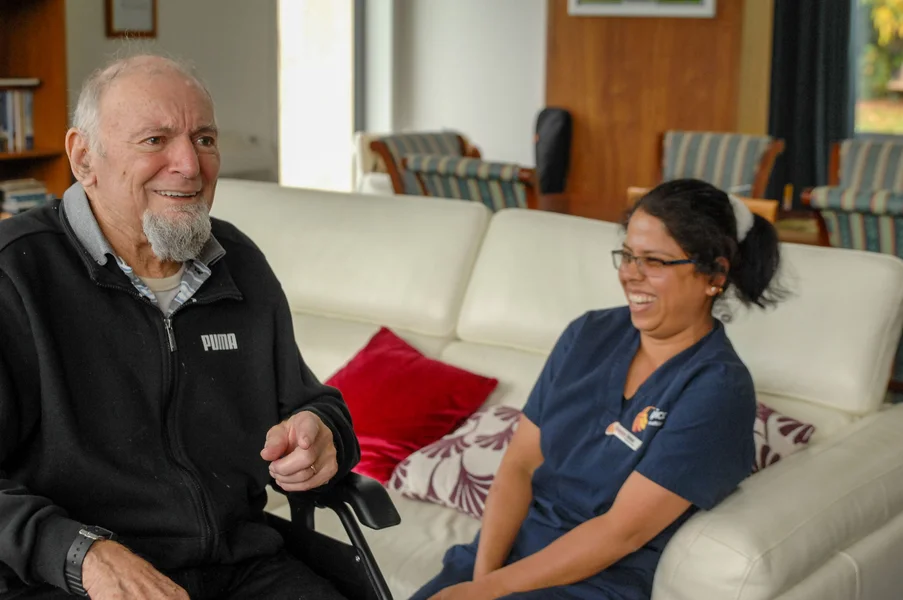
Who Hospice South supports
Hospice South provides specialist palliative care for patients
with life-limiting conditions, including but not limited to:
+ Cancer
+ Advanced cardiac disease
+ Chronic respiratory disease
+ Neurological conditions
+ Dementia
+ Renal disease
+ Other progressive life-limiting illnesses
Hospice involvement is not limited to the final days of life. Early
referral can support better symptom management, planning, and patient and whānau support.
If you are uncertain about eligibility, we welcome a conversation.
How to refer a patient
Referring a patient to Hospice South is straightforward.
Referrals are welcome from GPs, hospital teams, and other health professionals. If you are unsure whether a patient is suitable for hospice support, we encourage you to contact us to discuss.
Early referral is encouraged, and hospice involvement can begin at any stage of a life-limiting illness.
To make a referral:
We will review the referral and make contact to coordinate next steps.
Clinical Order Articulating Scope of Treatment
A Clinical Order Articulating Scope of Treatment (COAST) form is an individualised plan for end of life care that considers both patient preferences and clinical judgment based on medical evaluation. It is a communication tool for health professionals with a set of default orders that can be easily utilized across all health settings and encounters. The aim of the COAST process is to efficiently communicate and coordinate goal-directed clinical care, thereby improving the end of life experience for patients and families.
COAST is based on the POLST process in the United States and the Goals of Care initiative in Australia. It has been adapted to the New Zealand population.
This form is completed by either a doctor (any grade) or nurse practitioner after thorough patient/proxy discussion regarding the patient’s treatment preferences and current health status. Just as a written prescription does not replace a comprehensive discussion about medications with the patient/proxy, the COAST form is not a substitute for advance care planning discussions.
In order to be valid, each field should be completed and the form must be signed and dated by the treating doctor or nurse practitioner (NP).
COAST Form & Process Video
Please find below all of the downloadable forms:
Forms can be electronically uploaded to Health Connect South.
PLEASE NOTE: We are not currently recruiting participants for our research study so these forms are no longer required when a COAST Form is completed.
COAST Frequently Asked Questions
Who should have a coast form?
At this time, the COAST form is intended only for adult patients (age 18 or older).
Whose job is it to complete and sign the coast form
Where should a coast form be kept
Can the preferences on a coast form be changed?
Yes. A COAST form can be changed in one of two ways:
- By completing and signing a new COAST form. The new COAST form automatically replaces any previous version(s). The valid COAST form is the one that is most recently completed, signed, and dated.
- By revoking the original COAST form and leaving it unreplaced. This can be done at the request of the patient, proxy, or treating doctor/nurse practitioner. Revocation is documented in writing by striking through the COAST document and writing “REVOKED” along with the date, a brief explanation of the revocation, and the signature and printed name of the health provider.
Can the orders on the coast form be disregarded
Yes. The orders on a COAST form may be disregarded in the following circumstances:
- If fulfilling these orders involve providing medical care which is not equivalent to current healthcare standards.
- If the authenticity of the COAST form is called into question
- If all fields are not completed and/or the form is not signed/dated by the doctor/nurse practitioner.
Should the coast form be reviewed?
The COAST form does not have an expiration date. COAST form should be reviewed periodically and updated as appropriate if:
- There is a significant change in an individual’s health status
- The individual’s treatment preferences change
Does the coast form replace advanced care planning?
What if a facility has its own process for documenting clinical treatment decisions?
How we work alongside you
Hospice South provides:
+ Specialist palliative nursing support
+ Medical oversight in collaboration with the primary clinician
+ Symptom management guidance
+ Support for complex psychosocial needs
+ Family and whānau support
+ Inpatient care when required
The patient’s GP or primary clinician retains overall medical responsibility unless otherwise agreed.
We prioritise clear communication and collaborative care planning.
Geographic coverage
Hospice South supports patients across Southland and the Wakatipu Basin.
If you are unsure whether a patient falls within our service area, please contact us to discuss.
When to refer
Consider referral when:
+ Symptom complexity is increasing
+ The patient would benefit from additional specialist palliative input
+ There is increasing psychosocial or family distress
+ Advance care planning support is needed
+ Community coordination is becoming more complex
Early engagement often improves outcomes for patients and whānau.
Unsure if a patient is suitable?
Call our team to discuss – we’re happy to help.
Clinical collaboration
We recognise the importance of continuity of care and professional relationships.
Hospice South is committed to:
+ Clear communication
+ Shared decision-making
+ Respect for the patient’s existing care team
+ Supporting you in managing complex cases
We welcome direct communication regarding patient suitability, symptom advice, or shared care planning.